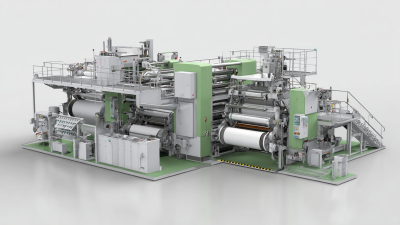
Choosing an Integrated Calendering And Slitting Machine requires more than comparing speed and price. The right system must match your material, production width, coating thickness, and finishing requirements. Film, rubber, nonwoven fabric, and specialty sheets respond differently under pressure and heat. Small differences matter.
Dr. John L. White, a respected polymer-processing expert, stated, “Processing equipment should be judged as part of the complete system.” This principle fits modern converting lines. A machine may offer impressive output, yet poor tension control can create wrinkles, uneven thickness, or damaged edges. Those defects become visible under bright inspection lights. They also increase waste during rewinding.
This guide examines the practical details behind a reliable purchase. Consider calender roll temperature stability, nip pressure, web alignment, slitting accuracy, and automatic tension adjustment. Check whether the control system records production data and identifies faults clearly. Ask about knife changes, cleaning access, spare parts, and technician response times. These details often decide whether the machine performs well after installation.
Do not trust speed alone.
A higher rated speed may reduce quality when the material is sensitive. A compact machine may save floor space, but limit future expansion. The cheapest quotation may exclude essential tooling or commissioning support. That assumption can fail. Buyers should compare total operating cost, energy use, maintenance needs, and operator training. The best Integrated Calendering And Slitting Machine is not simply the fastest option. It is the system that delivers stable quality, controlled waste, and dependable production over time. Personally, I would leave room for review after the first trial run. Real materials can challenge even a careful specification.
When choosing an integrated calendaring and slitting machine, define the material range before comparing speed or automation. The target thickness may run from 20 to 500 μm. That is a demanding span. A 20 μm film can wrinkle under excessive tension, while a 500 μm sheet needs stronger pressure and stable gap control. Request trial data across several thickness points, not only one ideal sample. Small errors become visible quickly.
Width requirements also shape the machine design. A web from 20 to 2,000 mm may need adjustable guides, accurate edge tracking, and flexible slitting tools. Narrow strips require precise knife positioning and clean edge separation. Wide webs expose problems in roll alignment, temperature balance, and transverse thickness variation. Check whether the machine can maintain consistent output near both width limits. Test the smallest practical width.
Output planning should include daily volume, roll diameter, winding quality, and changeover time. Integrated controls can coordinate calendaring pressure, line speed, web tension, and slitting position. However, automation does not correct poor material preparation. Measure thickness with calibrated equipment and record actual production conditions. Operators should inspect edges, wrinkles, hardness, and roll tightness during trials. A perfect specification rarely exists; real materials vary with moisture, temperature, and formulation. Leave room for adjustment, because the first successful trial may still hide a repeatability problem.
How to Choose an Integrated Calendering and Slitting Machine
An integrated calendering and slitting machine should be judged by control quality, not appearance. During production trials, measure the roll gap at several points across the web. A stated accuracy of ±1 μm can support stable thickness, but only when sensors, frame rigidity, and thermal control work together. Small temperature changes can alter the gap. That detail is easy to overlook.
Speed range matters just as much. A machine operating from 0.1 to 100 m/min can handle slow laboratory adjustments and faster continuous production. At 0.1 m/min, operators can inspect coating flow and edge behavior carefully. At higher speeds, tension control becomes critical before slitting begins. Watch for wrinkles, uneven winding, and gradual thickness drift. They often reveal problems earlier than alarms.
Ask for recorded test data, not only catalogue values. Check gap accuracy under load, speed stability, thickness variation, and slit-width tolerance. I have found that impressive numbers sometimes describe ideal conditions, not daily operation. The machine may reach ±1 μm briefly, yet lose consistency after extended heating. Request a long-duration trial using your actual material. Also examine recipe storage, calibration access, emergency stopping, and operator training. A technically strong system still creates waste when adjustments are unclear. That is worth questioning.
Specify slitting performance before comparing machine features. A 2024 Grand View Research report valued the global flexible packaging market at over USD 200 billion, showing why repeatable web quality matters. For precision films, request a verified width tolerance of ±0.1 mm. Do not accept a brochure claim alone. Ask for measured results across different roll widths and materials.
Stable web tension protects edges, winding quality, and downstream processing. Uneven tension can create wrinkles, telescoping rolls, or hidden thickness variation. A practical system should combine closed-loop tension control, responsive load cells, and a calibrated unwind brake. The machine should also maintain tension during acceleration, deceleration, and roll changes. Real production is less forgiving. ±0.1 mm may fail if the material stretches under heat or pressure.
Tips: Run a witnessed trial using your actual film. Measure ten slit rolls, not one. Record tension, speed, temperature, and roll hardness. Compare edge quality after storage. AIMCAL converting guidance highlights the importance of controlled web handling, but every material behaves differently. I would also question whether the tolerance remains stable after several hours. That detail is easy to miss.
How to Choose an Integrated Calendering and Slitting Machine
Evaluate line integration before comparing machine speed. The IEA’s Global EV Outlook 2024 reported that battery demand for electric vehicles exceeded 750 GWh in 2023. This growth increases pressure on manufacturers to control thickness, tension, and yield across every process stage.
Roll pressure must remain stable across the working width. A small pressure drift can create density variation, edge cracks, or uneven pore structure. Match the calendering force with web speed, material elasticity, and target porosity. Unwinding should provide responsive tension control without stretching the electrode. Rewinding needs a firm, aligned roll, but excessive torque can damage coated edges. Inspection systems should measure thickness, surface defects, wrinkles, and splice quality in real time. Reports from the U.S. Department of Energy emphasize process consistency as a key factor in scaling lithium-battery manufacturing.
Tips: Ask suppliers for tension maps, pressure profiles, and inspection samples from comparable materials. Test the full line, not isolated modules. Check how quickly operators can change roll width and recipe settings. Data logging matters. It exposes drift before scrap becomes expensive.
One practical warning: higher speed does not always mean higher output. A fast line with unstable unwinding may create more waste than a slower, balanced system. I have seen specifications look impressive while maintenance access remained poor. Leave room for calibration, cleaning, and operator inspection. That detail is easy to underestimate.
| Evaluation Dimension | Reference Requirement | Configuration A Standard Film Line |
Configuration B Precision Coated Web Line |
Configuration C Heavy-Gauge Web Line |
|---|---|---|---|---|
| Typical material thickness | Select the calendering load and tension range according to the finished web thickness. | 20–150 µm | 50–300 µm | 0.3–2.0 mm |
| Maximum web width | The usable width should include edge-trim allowance and the required number of slit lanes. | 1,300 mm | 1,600 mm | 2,000 mm |
| Operating line speed | Confirm that the calender, slitter, inspection camera, and winding controls share the same rated speed. | 10–80 m/min | 10–120 m/min | 5–60 m/min |
| Calender roll diameter | Larger rolls generally provide greater stiffness and more stable nip geometry under load. | 300 mm | 400 mm | 500 mm |
| Maximum line pressure | Pressure capacity must cover the target caliper reduction without exceeding material deformation limits. | 80 kN/m | 120 kN/m | 180 kN/m |
| Roll-gap control resolution | Use closed-loop gap control when thickness uniformity is critical. | ±2 µm | ±1 µm | ±3 µm |
| Unwinding roll diameter | The unwind capacity should support the planned production roll weight and minimize splice frequency. | 800 mm | 1,000 mm | 1,200 mm |
| Unwind tension range | Tension control must remain stable during roll diameter reduction and acceleration or deceleration. | 20–250 N | 15–350 N | 50–600 N |
| Tension zoning | Independent zones help prevent web stretching between calendering, inspection, slitting, and rewinding. | 3 zones | 4 zones | 4 zones |
| Slitting width range | Check the narrowest finished width, knife clearance, and required lane-count flexibility. | 50–1,300 mm | 30–1,600 mm | 100–2,000 mm |
| Slitting method | Choose the knife arrangement according to material strength, dust generation, and edge-quality requirements. | Razor or shear knife | Shear knife | Crush or shear knife |
| Rewinding roll diameter | Rewind diameter and shaft capacity must match the downstream handling and packaging process. | 600 mm | 800 mm | 1,000 mm |
| Rewind tension control | Taper tension and differential winding are recommended for multilane rolls and pressure-sensitive webs. | Programmable taper tension | Taper tension with lay-on control | Differential-shaft winding |
| Inspection capability | Inspection should cover the defect types that can cause downstream rejection or customer complaints. | Surface defects and missing coating | Surface, edge, streak, and pinhole defects | Surface defects and dimensional edge defects |
| Inspection resolution | Resolution depends on camera field of view, web speed, lighting, and the smallest defect to be detected. | 0.5 mm defect threshold | 0.25 mm defect threshold | 1.0 mm defect threshold |
| Thickness measurement | Use a suitable non-contact gauge when continuous caliper monitoring is required. | Optional, 1–200 µm range | Integrated, 1–500 µm range | Optional, 0.1–3.0 mm range |
| Control-system integration | A shared recipe should coordinate speed, pressure, tension, slit position, inspection alarms, and roll changes. | Central PLC and HMI | Central PLC, HMI, and quality database | Central PLC with load-monitoring interface |
| Recommended integration priority | Use the highest-priority items as acceptance-test criteria before purchasing. | Balanced cost and flexibility | Highest inspection and thickness control | Maximum load and roll capacity |
Choosing an integrated calendering and slitting machine starts with safety evidence, not polished brochures. Ask for a documented risk assessment based on ISO 12100 design principles. It should identify crushing points, hot rolls, sharp knives, and unexpected start-up. During a factory visit, watch how guards open, how interlocks stop motion, and whether emergency stops are reachable. Test these controls with an operator, not only an engineer. Small gaps matter. A clear maintenance procedure should cover lockout, cool-down time, and safe knife changes. Request validation records, training materials, and revision dates. If documents look copied or vague, pause the purchase.
Edge control reveals the machine’s practical quality. Inspect web guiding, tension sensors, trim removal, and slit-width adjustment at real production speed. A stable edge should not wander when roll hardness or material thickness changes. Measure finished rolls across several hours, then compare width, telescoping, dust, and loose edges. Operators often notice defects before software alarms do. Listen to them. For 24/7 reliability, review thermal stability, bearing temperatures, spare-part access, remote diagnostics, and service response coverage. Ask for uptime data from comparable duty cycles, not an optimistic laboratory figure. Run a prolonged acceptance test with planned stops and fault recovery. My own checks include one uncomfortable question: what fails first? No machine is perfect, and ignoring that weakness creates expensive downtime.
A practical comparison of key selection indicators for ISO 12100-based safety design, edge-control performance, product consistency, and continuous operation. The percentages represent illustrative engineering acceptance targets; actual values should be verified during machine trials and factory acceptance testing.
Prioritize documented risk reduction, stable web guidance, low thickness variation, and dependable uptime rather than evaluating purchase price alone.